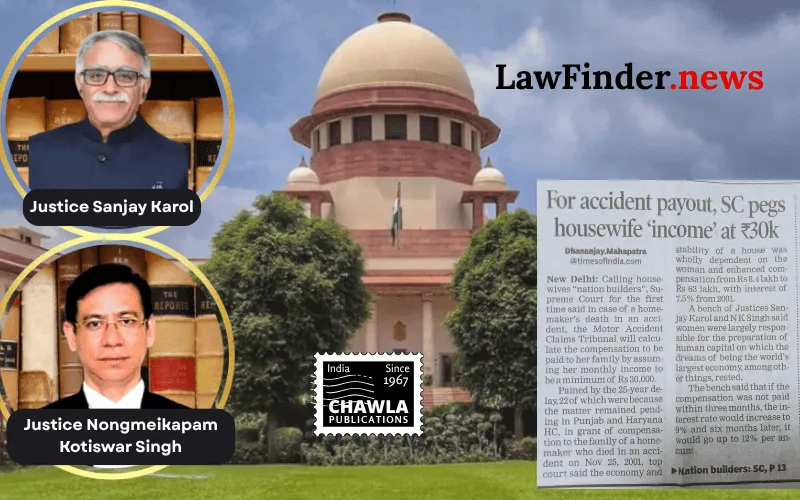
Landmark judgment addresses decades-long delays in motor accident claims, mandates expeditious disposal, and sets Rs. 30,000 monthly compensation for homemakers' death, acknowledging their multifaceted contributions beyond economic metrics.
In a landmark judgment delivered on June 11, 2026, the Supreme Court of India in the case of Shishu Pal @ Shish Ram v. Surjeet & Ors. (Civil Appeal No. 8456 of 2026) addressed two critical issues plaguing the adjudication of motor accident claims: the inordinate delay in disposal of cases and the undervaluation of homemakers' contributions in compensation awards following their death.
The case stemmed from a tragic accident dated November 25, 2001, wherein the deceased, a homemaker, lost her life due to rash and negligent driving by the respondent. The claim for compensation initiated in 2001 had languished for over two decades, highlighting systemic delays in the judicial process. The Supreme Court took judicial notice of this delay, revealing that average pendency in High Courts for motor accident claims spans approximately eight years, with tribunals taking around six years. A comprehensive table annexed to the judgment detailed the pendency of over 120 cases across various states, underscoring the urgency for institutional reforms.
The Court emphasized the need for expeditious adjudication and issued directions to High Courts to prioritize cases pending beyond four years, increase dedicated benches for Motor Accident Claims Tribunal (MACT) matters, and enforce strict adherence to summary procedures under Section 169 of the Motor Vehicles Act, 1988, to curb delays. It also mandated claimants to furnish necessary documentary proof such as age certificates, disability certificates, income proofs, and medical bills to avoid unnecessary adjournments.
On the substantive issue of compensation, the Court undertook a profound socio-legal analysis of the role of homemakers, terming them as "Nation Builders." It acknowledged that homemakers' contributions transcend mere economic valuation, encompassing emotional support, household management, child-rearing, and sustaining family cohesion. Drawing from economic studies like the 2019 Time Use Survey by the National Statistical Office and international recommendations, the Court recognized that unpaid domestic work by women amounts to a significant percentage of national GDP, yet remains unremunerated and undervalued.
The Court reviewed precedents, including Arun Kumar Agrawal v. National Insurance Co. Ltd. (2010), which recognized the invaluable services of a wife/mother, and National Insurance Co. Ltd. v. Pranay Sethi (2017), which established loss of consortium compensation. However, it noted that existing compensation frameworks inadequately capture the holistic loss suffered due to the death of a homemaker.
To bridge this gap, the Supreme Court introduced a new head of compensation titled "Loss of Domestic Care." It directed that in cases involving the death of a homemaker, a composite sum of Rs. 30,000 per month should be awarded under this head, subject to a 10% increase every three years. This amount is to serve as a stand-in for monthly income in cases where the homemaker does not have a formal income. If the homemaker also participates in the workforce, this compensation is to be awarded in addition to proven income.
Applying this principle to the present case, the Court recalculated the compensation to a substantial sum of Rs. 62,77,900/-, considering loss of domestic care, future prospects, loss of consortium for four dependents, loss of estate, and funeral expenses. Interest rates and conditions awarded by the High Court remained intact.
The Court also urged the legal fraternity and society to replace the term "housewife" with "homemaker" and further elevate it to "Nation Builder" in recognition of their critical societal role. This terminological shift reflects a modern understanding of gender roles and the indispensable contributions of homemakers to national development.
In conclusion, the Supreme Court's judgment is a clarion call for judicial efficiency in motor accident claims and a progressive redefinition of homemakers' value, ensuring just and fair compensation that reflects their true worth.
Statutory provision(s): Motor Vehicles Act, 1988, Section 169
Shishu Pal @ Shish Ram v. Surjeet, (SC) : Law Finder Doc id # 2921176